Receivables Control & Debt Collection
Sales invoice statuses, automatic reminders, and contact history next to the document, so receivables do not disappear into email and spreadsheets.
Issuing an invoice is not the end of the process
In many companies, the sales process ends when an invoice is issued and sent to the customer. Then manual checking begins: did the customer pay, does the payment cover the full amount, has the due date passed, who should send a reminder, and was a message already sent?
With more sales invoices, control gets harder. Some information sits in the invoicing system, some in the bank, some in email, and some in a finance spreadsheet. The company reacts too late or follows up without full context.
Altera treats receivables as the continuation of invoicing. After an invoice is issued, the team can track its status, update payment information, and communicate with the customer in connection with the specific document.
<PHOTO: sales invoice list with payment statuses: paid, partially paid, unpaid, overdue>
Receivable status visible next to the invoice
Every sales invoice has a payment status that helps the team quickly understand the situation: Paid, Partially Paid, Unpaid, or Overdue.
This gives finance a simple view of receivables without manually assembling a report. The team can see which invoices are closed, which have partial payments, which are still unpaid, and which need attention because the due date has passed.
<PHOTO: sales invoice details with payment status and partial payment information>
Reminders before, on, and after the due date
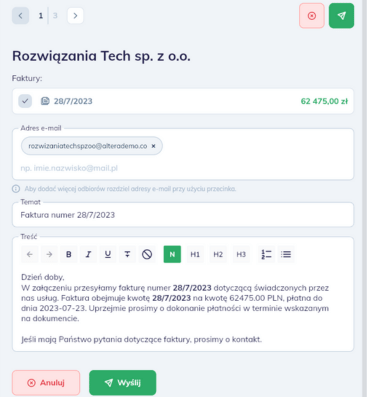
Altera can send automatic customer reminders at different stages: before the due date, on the due date, and after it is missed. The team does not have to manually watch every date and check who needs a message.
Automation does not remove control. A user can also manually generate an email with an invoice or a payment reminder when the customer situation requires an individual response.
<PHOTO: settings for automatic reminders before, on, and after the due date>
Message templates instead of writing from scratch
Every message has its own template, so the team does not write reminders from zero. Templates keep communication consistent while allowing the text to match the message type: invoice email, pre-due reminder, overdue reminder, or another follow-up.
That matters in soft collection. The customer receives a clear message, while the company avoids manually assembling emails with invoice number, amount, and due date.
<PHOTO: editing a payment reminder message template>
Contact history next to the document
The invoice keeps a history of sent emails and reminders. When someone returns to the document after a few days, they do not have to search the mailbox or ask the team whether the customer has already been reminded.
The history also prevents communication chaos. The team sees when the invoice was sent, when the reminder went out, and what actions were taken on the document.
<PHOTO: sales invoice history with sent emails and payment reminders>
Partial payments without losing status
Not every payment closes an invoice immediately. A customer may pay part of the amount, make several transfers, or settle after a reminder.
Altera supports partially paid invoices. The document status is not simply paid or unpaid: the team can see that part of the receivable has been covered, but the topic still needs monitoring.
<PHOTO: partially paid invoice with the remaining amount visible>
Late payment compensation note
We are working on automatic generation of a late payment compensation note covering the equivalent of EUR 40 under rules for late payments in commercial transactions.
This is the next step after soft reminders: when the customer misses the due date, the company can also organize the formal part of the process without preparing a document from scratch.
<PHOTO: planned view for generating a late payment compensation note>
Value for finance, sales, and leadership
For finance, this is a current view of which invoices are paid, partially paid, unpaid, or overdue. For sales and customer service, it is clear context for customer conversations. For leadership, it means better receivables visibility and lower risk that overdue payments are noticed too late.
The value is highest for companies that issue many invoices with deferred payment terms, handle partial payments, and regularly need to remind customers about overdue amounts.
Want to see this feature on your workflow?
In a demo, we will walk through your documents, roles, and edge cases to show where automation can help first.